
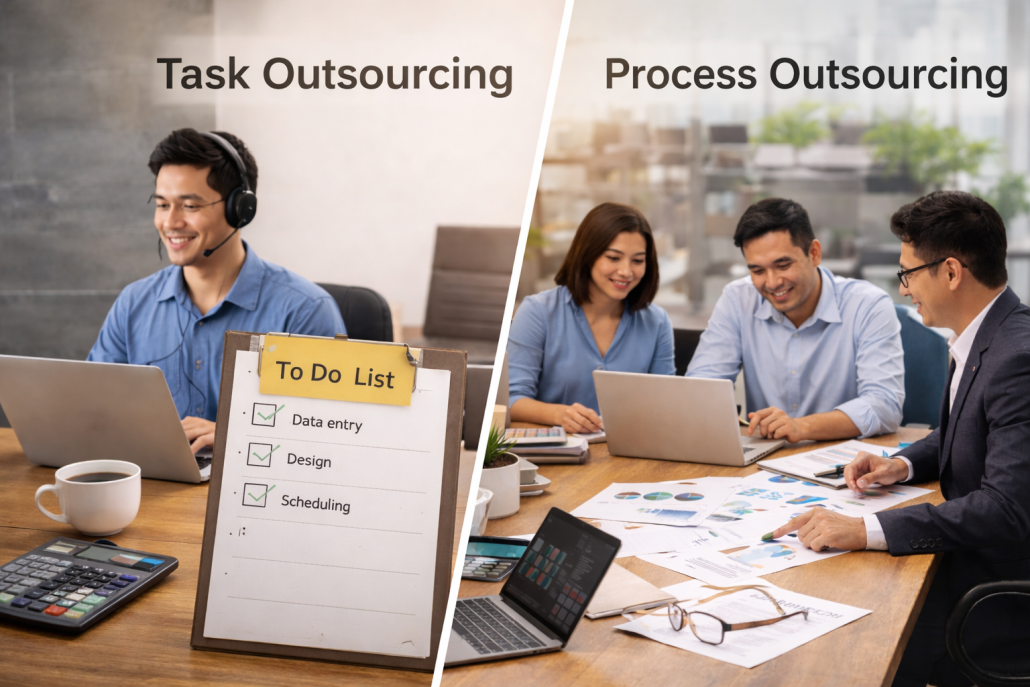
As American businesses look to scale in an increasingly competitive global market, the decision to leverage outsourcing is often a given. However, the strategy behind that move is what determines long-term success. Many executives find themselves at a crossroads: should they offload specific, isolated chores, or should they hand over entire functional workflows? This is the fundamental debate between task-based assistance and comprehensive process outsourcing. Understanding this distinction is vital for optimizing your bottom line and ensuring that your internal team can focus on high-value growth initiatives rather than administrative maintenance.
For most organizations, the journey begins with ‘task outsourcing.’ This involves delegating a specific, repeatable action, such as data entry, basic scheduling, or a one-off graphic design project to an external party. While this provides immediate relief for a busy manager, it requires constant oversight and micro-management. In contrast, process outsourcing is a strategic partnership where an external team manages an entire end-to-end function, such as your full accounting cycle, customer success department, or lead generation pipeline. By choosing the latter, you move away from managing people and start managing outcomes.
The Governance and Scope of Process Outsourcing
When a company transitions to a process outsourcing model, the governance structure shifts significantly. In a task-based setup, the client is responsible for defining the ‘how,’ ‘when,’ and ‘where’ of every individual action. This often results in a ‘bottleneck’ effect where the manager becomes the single point of failure. When you outsource a process, however, the service provider takes ownership of the methodology. They bring their own best practices, software recommendations, and internal management layers to ensure the work is completed to a high standard.
The scope of these engagements is typically defined by Service Level Agreements (SLAs) that focus on results rather than hours worked. For instance, instead of paying for 40 hours of ‘calling leads,’ you are contracting for a specific conversion rate or a set number of qualified appointments per month. This maturity in governance allows outsourcing companies in America to bridge the gap between their domestic strategy and their international execution. It creates a system where the provider is incentivized to innovate and find efficiencies, as their success is directly tied to the performance of the entire workflow.
KPO, LPO, and BPO: Identifying Your Philippines Outsourcing Needs
To effectively implement process outsourcing, it is helpful to understand the different categories of service. Historically, most businesses started with BPO (Business Process Outsourcing), which covers high-volume, standardized administrative tasks. However, as the global talent pool has matured, we have seen a massive surge in KPO (Knowledge Process Outsourcing) and LPO (Legal Process Outsourcing). These models require highly specialized remote professionals who possess advanced degrees and industry-specific expertise, such as financial analysts, paralegals, or biomedical researchers.
In the context of Philippines outsourcing, the quality of talent available allows American firms to move beyond basic support. You can now outsource complex processes like full-cycle recruitment, architectural drafting, or litigation support. The key is to identify which parts of your business are core and which are context. While your core strategy stays in-house, the context—even if it requires high-level knowledge can be managed by an expert offshore team. This allows your domestic staff to stay lean and agile, focusing exclusively on the innovations that differentiate your brand in the US market.
Measuring Cost and ROI Timing in Outsourcing Philippines
One of the primary drivers for outsourcing Philippines is, undoubtedly, cost reduction. However, the ROI timing differs greatly between task and process models. Task outsourcing provides instant gratification in terms of cost savings because you are simply replacing a high-cost hour with a low-cost hour. However, the ROI of process outsourcing is often cumulative. While there may be a slightly longer onboarding phase as the provider learns your intricate workflows, the long-term ROI is far superior. This is because a process-driven team identifies waste in your system and optimizes the workflow to be more efficient over time.
When you work with a Philippines recruitment agency, the focus should be on finding talent that can grow into these process owner roles. The initial investment in training and system integration pays dividends when your offshore team begins to operate autonomously. Instead of just saving costs on payroll, you are gaining an ‘efficiency engine’ that scales with your business. For American SMEs, this means you can compete with much larger corporations by maintaining a sophisticated operational infrastructure at a fraction of the traditional overhead cost.
Selecting the Right Recruitment Company Philippines for Your Strategy
The success of any offshore venture hinges on the quality of the people involved. This is why choosing a reputable recruitment company Philippines is a non-negotiable step. A general job board won’t suffice when you are looking for remote professionals who can manage an entire process. You need an agency that understands the nuances of the American business culture and the technical requirements of your specific industry. They act as your ‘boots on the ground,’ vetting candidates for both skill and cultural alignment.
A top-tier Philippines recruitment agency will go beyond just sending resumes. They will help you define the SLAs and KPIs necessary to track the success of your process outsourcing efforts. They understand that a process is only as good as the people running it. By providing ongoing HR support, secure office environments, and professional development, these agencies ensure that your offshore team remains stable and motivated. This stability is the bedrock upon which you can build a global operation that functions seamlessly across time zones.
Scaling Your Vision with Flat Planet
Navigating the transition from simple tasks to complex process outsourcing requires a partner who understands both the American corporate landscape and the immense potential of the Philippine talent market. When you stop looking for helpers and start looking for ‘process partners,’ you unlock a level of scalability that was previously reserved for Fortune 500 companies. The goal is to build a team that doesn’t just do what they’re told,but understands the why behind every action.
At Flat Planet, we specialize in helping US businesses move beyond the limitations of task-based hiring. We provide the high-caliber remote professionals and the structured environment needed to make outsourcing Philippines a true strategic win. Whether you are looking to optimize your BPO workflows or need high-level KPO support, our expertise as a leading recruitment company Philippines ensures that you get the right talent the first time. We handle the complexities of local governance and infrastructure so you can focus on leading your industry. Contact us today to learn how we can help you design a process-driven team that fuels your American growth.